


gibasa is a lightweight Rcpp wrapper for MeCab, a morphological analyzer for CJK text.
Morphological analysis is essential when processing CJK languages
because words are typically not separated by whitespace. Simple
tokenizers such as tokenizers::tokenize_words() may
therefore split text into incorrect tokens.
The goal of gibasa is to provide a tidytext-style tokenization workflow for CJK text. To support this workflow, gibasa provides three main functions:
gibasa::tokenize() — tokenize text using MeCabgibasa::prettify() — expand MeCab feature strings into
columnsgibasa::pack() — reconstruct whitespace-separated
text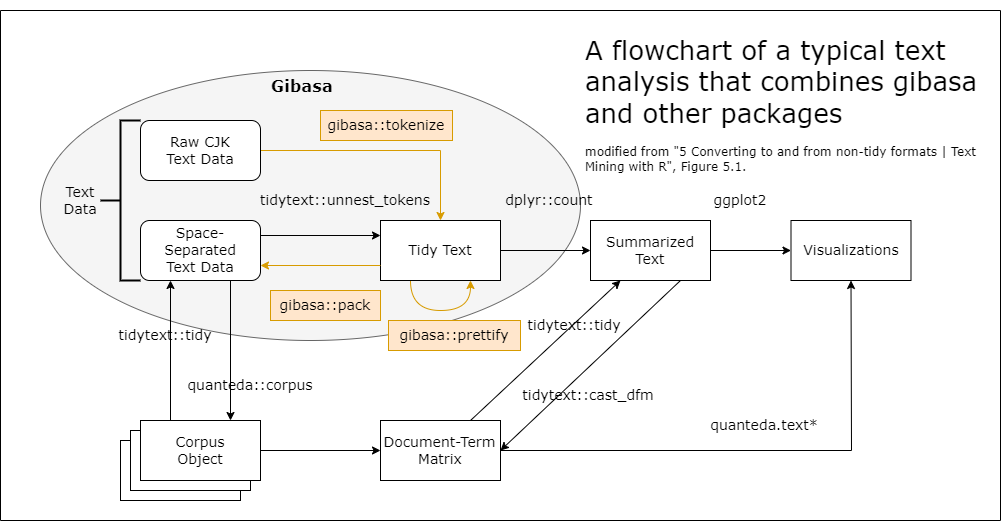
tokenize() converts a TIF-compliant data frame into tidy
token data so that it can be used as a drop-in alternative to
tidytext::unnest_tokens() for CJK text processing.
prettify() parses the feature string returned by MeCab
and splits it into structured columns.
pack() performs the reverse transformation and
reconstructs a whitespace-separated corpus from tidy tokens.
You can install gibasa from CRAN or r-universe.
## Install gibasa from r-universe
install.packages(
  "gibasa",
  repos = c("https://paithiov909.r-universe.dev", "https://cloud.r-project.org")
)

## Or install the development version
Sys.setenv(MECAB_DEFAULT_RC = "/fullpath/to/your/mecabrc") # if necessary
remotes::install_github("paithiov909/gibasa")
To use gibasa, a MeCab dictionary must be available on the system.
On Linux and macOS, MeCab and dictionaries can usually be installed using the system package manager. On Windows, use the installer available here.
Note that gibasa requires a UTF-8 dictionary, not a Shift-JIS one.
Since v0.9.4, gibasa reads configuration from either
MECABRC environment variable,
or~/.mecabrcIf your dictionary is installed in a non-standard location, create a mecabrc file that specifies the dictionary directory.
For a quick IPA dictionary setup, you can use ipadic from PyPI.
$ python3 -m pip install ipadic
$ python3 -c "import ipadic; print('dicdir=' + ipadic.DICDIR);" > ~/.mecabrcres <- gibasa::tokenize(
data.frame(
doc_id = seq_along(gibasa::ginga[5:8]),
text = gibasa::ginga[5:8]
),
text,
doc_id
)
res
#> # A tibble: 187 × 5
#> doc_id sentence_id token_id token feature
#> <fct> <int> <int> <chr> <chr>
#> 1 1 1 1 記号,空白,*,*,*,*, , ,
#> 2 1 1 2 カムパネルラ 名詞,一般,*,*,*,*,*
#> 3 1 1 3 が 助詞,格助詞,一般,*,*,*,が,ガ,ガ
#> 4 1 1 4 手 名詞,一般,*,*,*,*,手,テ,テ
#> 5 1 1 5 を 助詞,格助詞,一般,*,*,*,を,ヲ,ヲ
#> 6 1 1 6 あげ 動詞,自立,*,*,一段,連用形,あげる,アゲ,アゲ……
#> 7 1 1 7 まし 助動詞,*,*,*,特殊・マス,連用形,ます,マシ,マシ……
#> 8 1 1 8 た 助動詞,*,*,*,特殊・タ,基本形,た,タ,タ……
#> 9 1 1 9 。 記号,句点,*,*,*,*,。,。,。
#> 10 1 1 10 それ 名詞,代名詞,一般,*,*,*,それ,ソレ,ソレ……
#> # ℹ 177 more rowsgibasa::prettify(res)
#> # A tibble: 187 × 13
#> doc_id sentence_id token_id token POS1 POS2 POS3 POS4 X5StageUse1
#> <fct> <int> <int> <chr> <chr> <chr> <chr> <chr> <chr>
#> 1 1 1 1 記号 空白 <NA> <NA> <NA>
#> 2 1 1 2 カムパネルラ 名詞 一般 <NA> <NA> <NA>
#> 3 1 1 3 が 助詞 格助詞…… 一般 <NA> <NA>
#> 4 1 1 4 手 名詞 一般 <NA> <NA> <NA>
#> 5 1 1 5 を 助詞 格助詞…… 一般 <NA> <NA>
#> 6 1 1 6 あげ 動詞 自立 <NA> <NA> 一段
#> 7 1 1 7 まし 助動詞 <NA> <NA> <NA> 特殊・マス
#> 8 1 1 8 た 助動詞 <NA> <NA> <NA> 特殊・タ
#> 9 1 1 9 。 記号 句点 <NA> <NA> <NA>
#> 10 1 1 10 それ 名詞 代名詞…… 一般 <NA> <NA>
#> # ℹ 177 more rows
#> # ℹ 4 more variables: X5StageUse2 <chr>, Original <chr>, Yomi1 <chr>,
#> # Yomi2 <chr>
gibasa::prettify(res, col_select = 1:3)
#> # A tibble: 187 × 7
#> doc_id sentence_id token_id token POS1 POS2 POS3
#> <fct> <int> <int> <chr> <chr> <chr> <chr>
#> 1 1 1 1 記号 空白 <NA>
#> 2 1 1 2 カムパネルラ 名詞 一般 <NA>
#> 3 1 1 3 が 助詞 格助詞 一般
#> 4 1 1 4 手 名詞 一般 <NA>
#> 5 1 1 5 を 助詞 格助詞 一般
#> 6 1 1 6 あげ 動詞 自立 <NA>
#> 7 1 1 7 まし 助動詞 <NA> <NA>
#> 8 1 1 8 た 助動詞 <NA> <NA>
#> 9 1 1 9 。 記号 句点 <NA>
#> 10 1 1 10 それ 名詞 代名詞 一般
#> # ℹ 177 more rows
gibasa::prettify(res, col_select = c(1, 3, 5))
#> # A tibble: 187 × 7
#> doc_id sentence_id token_id token POS1 POS3 X5StageUse1
#> <fct> <int> <int> <chr> <chr> <chr> <chr>
#> 1 1 1 1 記号 <NA> <NA>
#> 2 1 1 2 カムパネルラ 名詞 <NA> <NA>
#> 3 1 1 3 が 助詞 一般 <NA>
#> 4 1 1 4 手 名詞 <NA> <NA>
#> 5 1 1 5 を 助詞 一般 <NA>
#> 6 1 1 6 あげ 動詞 <NA> 一段
#> 7 1 1 7 まし 助動詞 <NA> 特殊・マス
#> 8 1 1 8 た 助動詞 <NA> 特殊・タ
#> 9 1 1 9 。 記号 <NA> <NA>
#> 10 1 1 10 それ 名詞 一般 <NA>
#> # ℹ 177 more rows
gibasa::prettify(res, col_select = c("POS1", "Original"))
#> # A tibble: 187 × 6
#> doc_id sentence_id token_id token POS1 Original
#> <fct> <int> <int> <chr> <chr> <chr>
#> 1 1 1 1 記号
#> 2 1 1 2 カムパネルラ 名詞 <NA>
#> 3 1 1 3 が 助詞 が
#> 4 1 1 4 手 名詞 手
#> 5 1 1 5 を 助詞 を
#> 6 1 1 6 あげ 動詞 あげる
#> 7 1 1 7 まし 助動詞 ます
#> 8 1 1 8 た 助動詞 た
#> 9 1 1 9 。 記号 。
#> 10 1 1 10 それ 名詞 それ
#> # ℹ 177 more rowsres <- gibasa::prettify(res)
gibasa::pack(res)
#> # A tibble: 4 × 2
#> doc_id text
#> <fct> <chr>
#> 1 1 カムパネルラ が 手 を あげ まし た 。 それ から 四 、 五 人 手 を あげ まし た 。 ジョバンニ も 手 を あげよ う…
#> 2 2 ところが 先生 は 早く も それ を 見つけ た の でし た 。
#> 3 3 「 ジョバンニ さん 。 あなた は わかっ て いる の でしょ う 」
#> 4 4 ジョバンニ は 勢い よく 立ちあがり まし た が 、 立っ て みる と もう はっきり と それ を 答える こと が でき ない…
dplyr::mutate(
res,
token = dplyr::if_else(is.na(Original), token, Original),
token = paste(token, POS1, sep = "/")
) |>
gibasa::pack() |>
head(1L)
#> # A tibble: 1 × 2
#> doc_id text
#> <fct> <chr>
#> 1 1 /記号 カムパネルラ/名詞 が/助詞 手/名詞 を/助詞 あげる/動詞 ます/助動詞 た/助動詞 。/記号 それ/名詞 から/助詞 四/名…gibasa supports several dictionary schemes including:
## UniDic 2.1.2
gibasa::tokenize("あのイーハトーヴォのすきとおった風", sys_dic = file.path("mecab/unidic-lite")) |>
  gibasa::prettify(into = gibasa::get_dict_features("unidic26"))
#> # A tibble: 6 × 30
#>   doc_id sentence_id token_id token    POS1  POS2  POS3  POS4  cType cForm lForm
#>   <fct>        <int>    <int> <chr>    <chr> <chr> <chr> <chr> <chr> <chr> <chr>
#> 1 1                1        1 あの     感動詞…… フィラー… <NA>  <NA>  <NA>  <NA>  アノ
#> 2 1                1        2 イーハトーヴォ… 名詞  普通名詞… 一般  <NA>  <NA>  <NA>  <NA>
#> 3 1                1        3 の       助詞  格助詞…… <NA>  <NA>  <NA>  <NA>  ノ
#> 4 1                1        4 すきとおっ…… 動詞  一般  <NA>  <NA>  五段-ラ… 連用形-… スキトオ…
#> 5 1                1        5 た       助動詞…… <NA>  <NA>  <NA>  助動詞-… 連体形-… タ
#> 6 1                1        6 風       名詞  普通名詞… 一般  <NA>  <NA>  <NA>  カゼ
#> # ℹ 19 more variables: lemma <chr>, orth <chr>, pron <chr>, orthBase <chr>,
#> #   pronBase <chr>, goshu <chr>, iType <chr>, iForm <chr>, fType <chr>,
#> #   fForm <chr>, kana <chr>, kanaBase <chr>, form <chr>, formBase <chr>,
#> #   iConType <chr>, fConType <chr>, aType <chr>, aConType <chr>,
#> #   aModeType <chr>


## CC-CEDICT
gibasa::tokenize("它可以进行日语和汉语的语态分析", sys_dic = file.path("mecab/cc-cedict")) |>
  gibasa::prettify(into = gibasa::get_dict_features("cc-cedict"))
#> # A tibble: 9 × 12
#>   doc_id sentence_id token_id token POS1  POS2  POS3  POS4  pinyin_pron
#>   <fct>        <int>    <int> <chr> <chr> <chr> <chr> <chr> <chr>
#> 1 1                1        1 它    <NA>  <NA>  <NA>  <NA>  ta1
#> 2 1                1        2 可以  <NA>  <NA>  <NA>  <NA>  ke3 yi3
#> 3 1                1        3 进行  <NA>  <NA>  <NA>  <NA>  jin4 xing2
#> 4 1                1        4 日语  <NA>  <NA>  <NA>  <NA>  Ri4 yu3
#> 5 1                1        5 和    <NA>  <NA>  <NA>  <NA>  he2
#> 6 1                1        6 汉语  <NA>  <NA>  <NA>  <NA>  Han4 yu3
#> 7 1                1        7 的    <NA>  <NA>  <NA>  <NA>  di4
#> 8 1                1        8 语态  <NA>  <NA>  <NA>  <NA>  yu3 tai4
#> 9 1                1        9 分析  <NA>  <NA>  <NA>  <NA>  fen1 xi1
#> # ℹ 3 more variables: traditional_char_form <chr>, simplified_char_form <chr>,
#> #   definition <chr>


## mecab-ko-dic
gibasa::tokenize("하네다공항한정토트백", sys_dic = file.path("mecab/mecab-ko-dic")) |>
  gibasa::prettify(into = gibasa::get_dict_features("ko-dic"))
#> # A tibble: 4 × 12
#>   doc_id sentence_id token_id token  POS   meaning presence reading type
#>   <fct>        <int>    <int> <chr>  <chr> <chr>   <chr>    <chr>   <chr>
#> 1 1                1        1 하네다 NNP   인명    F        하네다  <NA>
#> 2 1                1        2 공항   NNG   장소    T        공항    <NA>
#> 3 1                1        3 한정   NNG   <NA>    T        한정    <NA>
#> 4 1                1        4 토트백 NNG   <NA>    T        토트백  Compound
#> # ℹ 3 more variables: first_pos <chr>, last_pos <chr>, expression <chr>## build a new ipadic in temporary directory
build_sys_dic(
dic_dir = file.path("mecab/ipadic-eucjp"), # replace here with path to your source dictionary
out_dir = tempdir(),
encoding = "euc-jp" # encoding of source csv files
)
#> reading mecab/ipadic-eucjp/unk.def ... 40
#> reading mecab/ipadic-eucjp/Adverb.csv ... 3032
#> reading mecab/ipadic-eucjp/Conjunction.csv ... 171
#> reading mecab/ipadic-eucjp/Suffix.csv ... 1393
#> reading mecab/ipadic-eucjp/Noun.adverbal.csv ... 795
#> reading mecab/ipadic-eucjp/Noun.others.csv ... 151
#> reading mecab/ipadic-eucjp/Noun.org.csv ... 16668
#> reading mecab/ipadic-eucjp/Verb.csv ... 130750
#> reading mecab/ipadic-eucjp/Noun.place.csv ... 72999
#> reading mecab/ipadic-eucjp/Noun.csv ... 60477
#> reading mecab/ipadic-eucjp/Adnominal.csv ... 135
#> reading mecab/ipadic-eucjp/Noun.number.csv ... 42
#> reading mecab/ipadic-eucjp/Noun.verbal.csv ... 12146
#> reading mecab/ipadic-eucjp/Filler.csv ... 19
#> reading mecab/ipadic-eucjp/Others.csv ... 2
#> reading mecab/ipadic-eucjp/Noun.adjv.csv ... 3328
#> reading mecab/ipadic-eucjp/Interjection.csv ... 252
#> reading mecab/ipadic-eucjp/Postp-col.csv ... 91
#> reading mecab/ipadic-eucjp/Noun.nai.csv ... 42
#> reading mecab/ipadic-eucjp/Prefix.csv ... 221
#> reading mecab/ipadic-eucjp/Noun.name.csv ... 34202
#> reading mecab/ipadic-eucjp/Symbol.csv ... 208
#> reading mecab/ipadic-eucjp/Adj.csv ... 27210
#> reading mecab/ipadic-eucjp/Noun.demonst.csv ... 120
#> reading mecab/ipadic-eucjp/Noun.proper.csv ... 27327
#> reading mecab/ipadic-eucjp/Postp.csv ... 146
#> reading mecab/ipadic-eucjp/Auxil.csv ... 199
#> reading mecab/ipadic-eucjp/matrix.def ... 1316x1316
#>
#> done!
## copy the 'dicrc' file
file.copy(file.path("mecab/ipadic-eucjp/dicrc"), tempdir())
#> [1] TRUE
dictionary_info(sys_dic = tempdir())
#> file_path charset lsize rsize size type version
#> 1 /tmp/Rtmp5oy3pj/sys.dic utf8 1316 1316 392126 0 102## write a csv file and compile it into a user dictionary
writeLines(
c(
"月ノ,1290,1290,4579,名詞,固有名詞,人名,姓,*,*,月ノ,ツキノ,ツキノ",
"美兎,1291,1291,8561,名詞,固有名詞,人名,名,*,*,美兎,ミト,ミト"
),
con = (csv_file <- tempfile(fileext = ".csv"))
)
build_user_dic(
dic_dir = file.path("mecab/ipadic-eucjp"),
file = (user_dic <- tempfile(fileext = ".dic")),
csv_file = csv_file,
encoding = "utf8"
)
#> reading /tmp/Rtmp5oy3pj/fileb3c375808b27.csv ... 2
#>
#> done!
tokenize("月ノ美兎は箱の中", sys_dic = tempdir(), user_dic = user_dic)
#> # A tibble: 6 × 5
#> doc_id sentence_id token_id token feature
#> <fct> <int> <int> <chr> <chr>
#> 1 1 1 1 月ノ 名詞,固有名詞,人名,姓,*,*,月ノ,ツキノ,ツキノ
#> 2 1 1 2 美兎 名詞,固有名詞,人名,名,*,*,美兎,ミト,ミト
#> 3 1 1 3 は 助詞,係助詞,*,*,*,*,は,ハ,ワ
#> 4 1 1 4 箱 名詞,一般,*,*,*,*,箱,ハコ,ハコ
#> 5 1 1 5 の 助詞,連体化,*,*,*,*,の,ノ,ノ
#> 6 1 1 6 中 名詞,非自立,副詞可能,*,*,*,中,ナカ,ナカGPL (>=3).